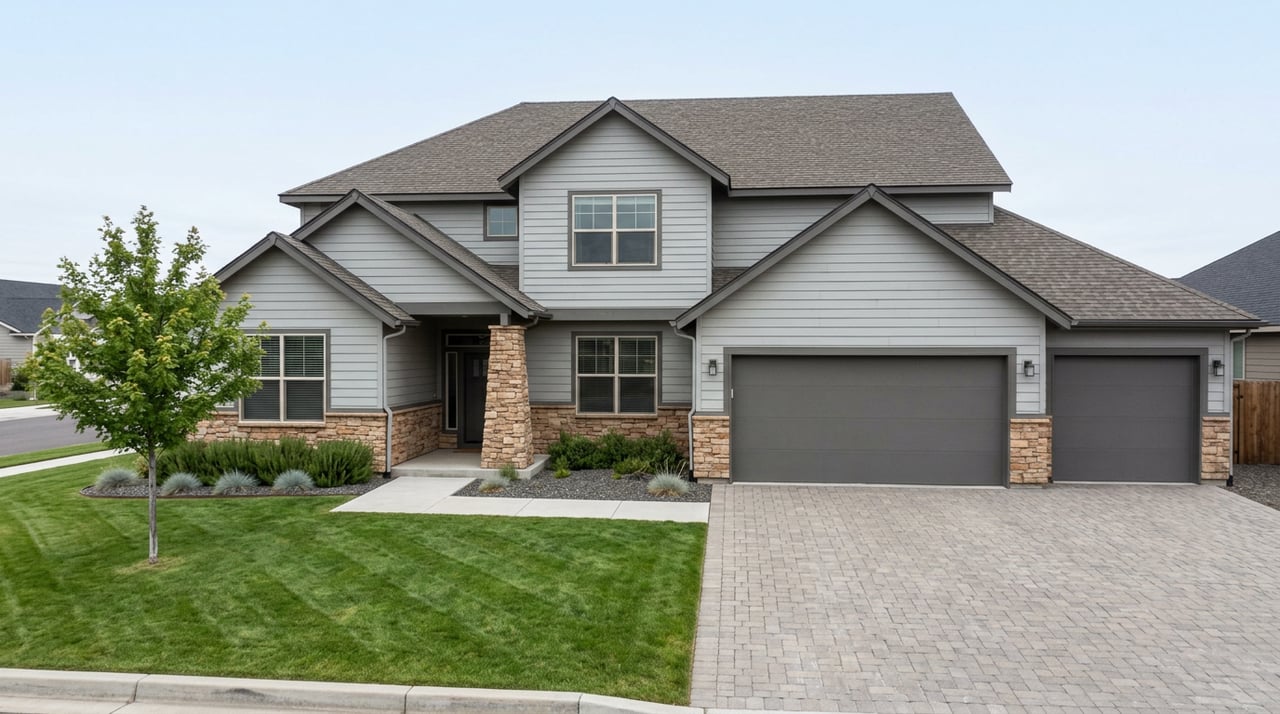
The Irrigation Question West Richland Buyers Forget to Ask Before They Write an Offer
September 24, 2026
September 24, 2026
The lots at Watermark sit atop the hill where Van Giesen meets Keene Road, and most of them look out at Red Mountain. It is the kind of view that sells a subdivision. Builders at Watermark, along with The Bluffs a few miles west and The Grove near Dallas and Kennedy roads, are platting hundreds of new parcels across West Richland right now, and a buyer walking one of those lots is thinking about square footage, orientation, and whether the kitchen faces the mountain. Almost nobody is thinking about who owns the pipe under the front lawn.
They should be. In West Richland, irrigation water is not a flat utility line item that comes bundled with the house the way it might in an older, fully built-out neighborhood. It is infrastructure that gets built in pieces, by different entities, on different timelines, and the bill for building it does not always land on the developer. Sometimes it lands on whoever owns the lot when the invoice comes due, spread across ten years of annual charges that never show up in a listing photo.
West Richland does not have one irrigation provider. Most of the city is served by Columbia Irrigation District, a small portion by Kennewick Irrigation District, and the city itself operates three additional small systems in LuAnne Estates, Brotherhood, and Flat Top Park that pump water from Columbia Irrigation District's own canals. Which of these applies to a specific parcel depends on where that parcel sits, not on the subdivision's marketing name or its builder.
That matters because a buyer touring a finished model home in one phase of a subdivision cannot assume the next phase over, or the lot two doors down, is served the same way. Growth corridors like Keene Road, where Watermark's newer phases are being platted, are exactly where district boundaries and delivery infrastructure are still being drawn. Kennewick Irrigation District filed a new master plan with the Washington Department of Ecology in January 2026 covering an area bounded by the Badger East Lateral, Interstate 182, and Keene Road, specifically to guide how the district extends replacement irrigation infrastructure as West Richland continues to develop. That filing is not historical record. It is an active project shaping how water gets delivered to lots that have not finished construction yet.
Even once a parcel has confirmed irrigation service, the second question is who maintains the pipe once it leaves the district's meter. Kennewick Irrigation District draws a hard line here: the district delivers water to a KID-owned point, and everything past that point in a Private Line Area is the responsibility of the property owner, sometimes coordinated through an HOA and sometimes not.
This is not a small technicality. KID's own explanation of how this happened is worth sitting with: when the district was formed it served agricultural land, and as farms were sold and subdivided, a single 40-acre orchard that once ran off one canal turnout might become 160 individual homes, all sharing a private irrigation system none of them built and none of them fully understand. Multiply that pattern across decades of subdivision in West Richland and Kennewick, and a buyer inheriting a home in a Private Line Area is often inheriting a shared system with murky ownership of who fixes what when a line breaks.
The lot you are touring might not have finished irrigation infrastructure at all yet. That is worth confirming in writing, not assuming from the sprinkler heads already installed on the model home next door.
Here is the part that actually changes how a buyer should think about cost. When a district extends its canal system, pump stations, or transmission lines into new growth, it does not typically eat that capital cost. It recovers it through surcharges attached to the specific parcels connected to the new infrastructure, billed annually for a fixed term, often ten years.
Kennewick Irrigation District's 2026 rate schedule makes this mechanism visible in dollars. Customers in the Red Mountain Service Area pay a $43.60 per acre capital surcharge plus a $45.29 per acre operating surcharge, on top of standard rates. Customers connected to the district's Division IV 33.8 transmission system pay $229.61 per acre annually for ten years if that charge has not been paid in full up front, and a separate distribution surcharge of $307.44 per acre applies to that same infrastructure zone. Highland Gardens Benefit Area customers pay $793.91 per Equivalent Irrigation Unit annually for a full decade if that charge has not already been paid in full.
None of these figures are hypothetical. They are line items on KID's published 2026 rate sheet right now, attached to real parcels in the district's service territory that includes Kennewick, Richland, West Richland, and Benton City. The mechanism they represent, build the infrastructure first and bill new parcels for capacity over years rather than folding it into a one-time price, is the same mechanism the January 2026 West Richland Master Plan is designed to extend into the corridors where Watermark, The Bluffs, and future phases of Lewis & Clark Ranch are being built.
None of this would matter much in a neighborhood that finished growing twenty years ago. West Richland is not that neighborhood. According to reporting in the Tri-Cities Area Journal of Business, the city issued 109 single-family building permits through early September 2025, up from 98 over the same stretch the year before, and its population grew 12 percent over the past five years to reach 18,430 residents in 2025. In August 2025, the city council unanimously approved a 20-year growth plan adding 3,800 more homes citywide along with commercial space and jobs. Separately, and at a much larger scale, developer Frank Tiegs LLC is moving forward with the first 770-acre phase of the 7,600-acre Lewis & Clark Ranch northwest of downtown, a project with long-term ambitions of up to 34,000 homes bordered on three sides by the Yakima River.
A $33.7 million, largely state-funded widening of Van Giesen Street is underway too, upgrading a three-mile stretch from near Red Mountain into the heart of the city with new lanes, sidewalks, and curbing, expected to finish in December 2026. City community development director Eric Mendenhall has described the pace of visible construction as constant, and the infrastructure that supports it, roads, sewer, and irrigation alike, is being built in the same rolling, phase-by-phase way the homes are.
That is precisely the environment where irrigation terms differ lot to lot within the same subdivision. A phase platted in 2023 may already have a fully paid-off delivery system. A phase platted in 2026 may be sitting inside the exact boundary of a master plan still being finalized with the state.
A buyer working with a builder or an agent on new construction anywhere in West Richland right now should get answers to three questions in writing before signing a purchase agreement, not after closing:
A title company will typically flag recorded liens and assessments before closing, but a multi-year district surcharge tied to infrastructure built for a whole growth corridor is not always structured the same way a standard assessment is. Getting the answer directly from the district, rather than assuming it mirrors a neighbor's bill, is worth the phone call.
Does every home in West Richland have irrigation water available? No. Coverage depends on which district serves that specific parcel and whether that phase of construction has completed its irrigation buildout. A green lawn in a listing photo does not confirm which system waters it.
Who do I call to confirm which district serves a parcel? Columbia Irrigation District can be reached at 509-586-6118, and Kennewick Irrigation District at 509-586-9111. Both maintain contact information for confirming service to a specific address.
Could this affect my closing timeline? It can affect what you are agreeing to pay long after closing rather than the closing date itself. A ten-year surcharge is a recurring cost, similar in structure to an HOA due, and it is worth having your closing team confirm in writing rather than assuming it will surface automatically.
West Richland's growth is real, and so is the opportunity in it, but the paperwork behind a new subdivision's water supply moves at its own pace. If you are comparing lots in Watermark, The Bluffs, or any of the newer phases going up around town and want someone who will ask these questions before you sign rather than after, Shana Brown has been tracking exactly this kind of West Richland infrastructure detail for buyers who would rather know now than find out on their first irrigation bill.
This article is general information, not legal, tax or financial advice. Consult a qualified professional about your situation.
Stay up to date on the latest real estate trends.
Get assistance in determining the current property value, crafting a competitive offer, writing and negotiating a contract, and much more. Contact me today.