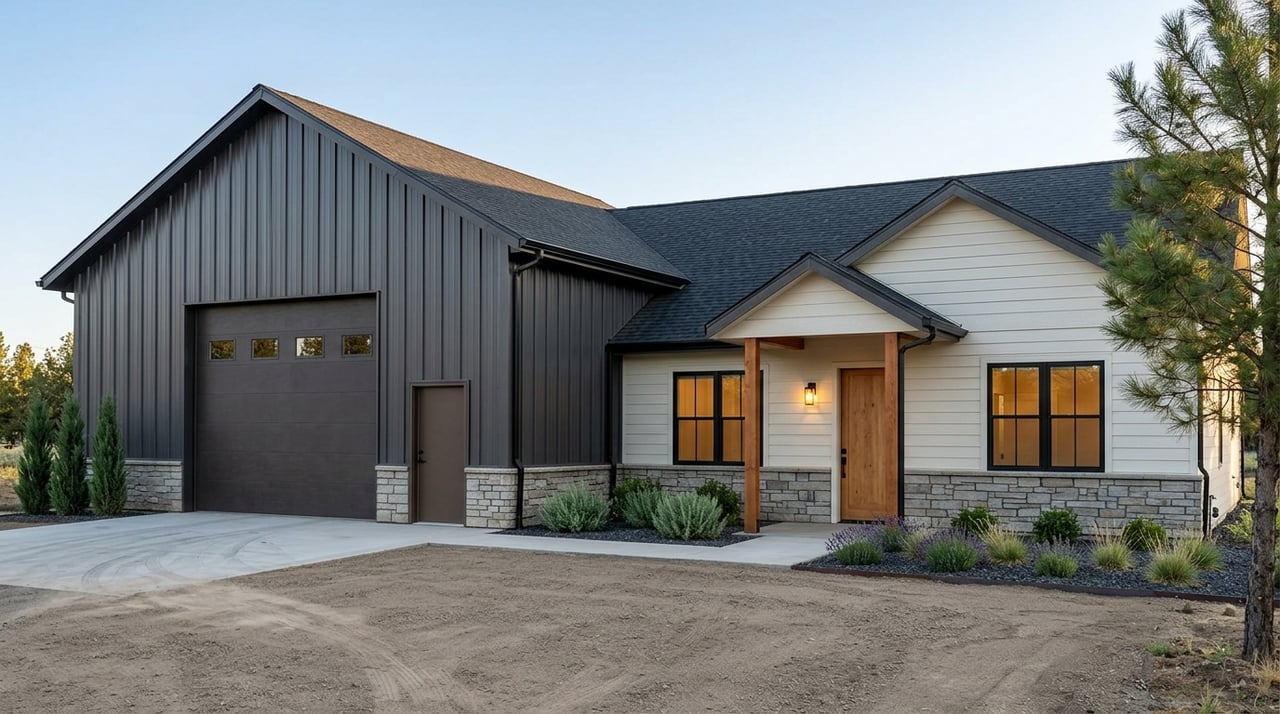
West Richland Barndominium Guide for Smart Planning
June 18, 2026
June 18, 2026
Thinking about building a barndominium or shop-home in West Richland? You are not alone. Many buyers love the idea of combining a home with a large shop, garage, or workspace, but the biggest surprise is that success usually depends less on the style name and more on the lot itself. If you are exploring land or planning a custom build, this guide will help you understand what matters most in West Richland so you can move forward with more confidence. Let’s dive in.
In West Richland, it is smartest to think of a barndominium or shop-home in plain terms: a residence paired with a significant shop, garage, or workspace area. That matters because city review focuses on zoning, use, dimensions, and site standards, not on whether a project is marketed under a popular nickname.
West Richland is a growing city in the Tri-Cities area, with an estimated 2024 population of 18,820. As the city continues to grow, parcel-specific details like zoning, utility access, setbacks, and site layout play a major role in whether your plan is workable.
If you are serious about building, the lot should be your first decision point. In West Richland, the same shop-home concept might work on one parcel and hit major limits on another.
The city’s official zoning map includes residential, mixed-use, commercial, and light-industrial districts. The land use matrix in the municipal code controls which uses are allowed, and any use not specifically permitted, conditionally permitted, or secondarily permitted is prohibited.
That means you should not assume any vacant lot can support a large home-plus-shop layout. The exact district, lot dimensions, and development standards need to line up before a project starts to make sense.
The City of West Richland directs property owners to verify zoning through the official zoning map and Title 17 of the municipal code. The city also points readers to Section 17.54 for key dimensional standards such as minimum setbacks, maximum building height, and lot coverage.
Accessory buildings are listed as secondarily permitted in the residential and commercial districts shown in the city’s land use matrix. In practical terms, that can make a shop-home possible on some lots, but only when the residential use and the accessory structure fit the district’s standards.
A larger shop-heavy design may be easier to place on one property than another. The lot’s location, zoning category, and physical layout are the first real filters for feasibility.
Inside city limits, the West Richland Community Development Department is the key starting point. This department handles building permits, zoning, subdivision regulations, GIS and mapping, SEPA review, site plan review, and variance requests.
The residential permit application shows how detailed the process can be. It asks for the jobsite address, parcel information, project valuation, contractor information, and lender information for projects valued over $5,000.
That is a good reminder that a shop-home is not a casual add-on project. It is a full construction process that needs planning from the beginning.
Even simple detached storage sheds are regulated in West Richland. According to the city FAQ, detached sheds 200 square feet or less require a no-fee permit and a site plan, while larger sheds require a building permit.
If a small shed needs city review, a full residence with a large shop certainly will. This is one reason it helps to do your due diligence early, before you buy land or finalize plans.
West Richland also expects contractors and subcontractors to have a city business license. If you are pricing a project, it helps to confirm early that the professionals you want to use are set up to work in the city.
The city also notes that a bright green inspection sign-off card shows permits have been obtained. It is a small local detail, but a helpful one if you are new to the building process.
A shop-home budget is about more than the structure itself. In West Richland, utility access can quickly affect what a build will cost and how complex it becomes.
The city offers water, sewer, stormwater, garbage, and irrigation services where available. Irrigation is provided for most of West Richland by Columbia Irrigation District, while a smaller portion of the city is served by Kennewick Irrigation District.
If you are comparing parcels, do not stop at the purchase price. Ask whether city water and sewer are available, how stormwater will be addressed, and what irrigation service applies to the property.
The city’s utility rate information notes that residents outside city limits who receive sewer service pay an additional 50% surcharge on the base rate. That can matter if you are looking at fringe acreage and trying to compare it with a parcel inside city limits.
A lower land price does not always mean a lower long-term cost. Service access and utility rates can change the math.
West Richland’s water system relies on seven groundwater wells plus an intertie connection with the City of Richland. For buyers who want a little more space but still hope for city water, that is useful context.
Stormwater also matters more than many buyers expect. Roof runoff, driveways, parking areas, and other hard surfaces are part of the site drainage picture, so your layout is not just about convenience. It is also part of the approval path.
If your parcel will use private septic or a private or community well, the process becomes more layered. In those cases, the county and health district become central to your planning.
Benton County’s single-family residence packet says septic approval comes from the Benton-Franklin District Health Department. It also says city sewer or water hook-up letters are needed when city service is available, and a private or community well requires a state-approved water availability form plus a well log.
The Benton-Franklin Health District states that it is illegal to construct an on-site sewage disposal system without first obtaining a permit. Soil profile holes may also be required, which can affect your timeline and due diligence period.
Not every property people call “West Richland” is inside the city limits. If you are looking at acreage or fringe land in unincorporated Benton County, you may be following a county path instead of a city one.
For those parcels, Benton County Building Division handles construction regulation in unincorporated areas. The county has adopted the 2021 Washington code cycle, effective March 15, 2024.
County materials also show that accessory structures larger than 200 square feet require a building permit. Plot plans must show property lines, setbacks, the proposed structure, and driveway location, which reinforces how site planning drives approval.
A shop-home build usually involves more than one permit. In addition to the main building permit, trade-specific approvals may apply depending on the site and scope.
Benton County’s building packet says electrical permits are obtained through the Washington Department of Labor and Industries. Washington L&I also states that electrical work in Washington requires a permit and inspection.
This is another reason your contractor team and timeline matter. The project needs coordination across multiple moving parts.
Many buyers focus on the build price and forget the full project budget. For a shop-home or barndominium, the structure is only one piece of the puzzle.
Construction financing is typically short-term and tied to building progress. A construction loan may cover the cost of building a home, and some loan structures convert into a longer-term mortgage after construction is complete.
For your planning, it helps to include:
Lenders and builders often need a realistic draw schedule and construction calendar. West Richland’s permit application also asks for lender information for projects over $5,000, which shows how early financing and permitting can connect.
If you want to avoid expensive surprises, follow a simple sequence. In West Richland, this order matches how local review tends to work.
Before you fall in love with a floor plan, focus on the lot. The parcel determines the zoning path, utility options, access, setbacks, and overall buildability.
Verify the zoning district and review what is allowed there. Check setbacks, lot coverage, and height limits so you know whether the home-and-shop concept fits the site.
Find out whether city water, sewer, stormwater, and irrigation are available. If not, confirm what will be required for septic and water approval.
Budget for more than the home shell. Driveways, grading, drainage, utility extensions, septic work, and permits can meaningfully affect total cost.
Once the lot checks out, bring in a local builder and lender. That helps you match your vision to a realistic construction plan and financing strategy.
A shop-home purchase often starts as a land decision before it becomes a home decision. That is where local market knowledge can save you time, money, and frustration.
When you are comparing parcels in and around West Richland, it helps to have someone who can spot the practical differences between city lots, fringe properties, and acreage. A responsive local agent can also help you ask better questions early, before you commit to the wrong parcel.
If you are considering land for a shop-home or barndominium in West Richland, Shana Brown can help you evaluate lots, understand the local path, and move forward with clear next steps.
Stay up to date on the latest real estate trends.
Get assistance in determining the current property value, crafting a competitive offer, writing and negotiating a contract, and much more. Contact me today.